Adhered film
Check the same drum surface for less visible film; its original scratches remain.
✅FDA approved
👍 20,000+ Satisfied Customers
👨⚕️Clinically Proven
🌈Try it risk-free with a full money-back guarantee
Couldn't load pickup availability

Shine is only part of the story. Check attached film, dried residue and loose flakes—then return to the same spot after cleaning.
Check the same drum surface for less visible film; its original scratches remain.
Look along the lifter edge for a reduction in the residue that had collected there.
Check the bottom of the empty drum for fine residue left after draining.
Look for reduced light deposits. Routine care is not a promise to remove years of heavy scale.
Illustrative visualization of residue changes. Compare the same area under the same light; these images are not measured test results.
The task can differ from one home to the next. Match your concern to the surface, the water conditions or the residue left at the end.
After removing laundry, check around the lifter for an attached film. Empty-machine cleaning helps loosen the residue left on reachable surfaces.
Review your household water information before planning maintenance. Hard-water support reduces interference in the cleaning liquid.
Once the machine has stopped, check the drum bottom. Dispersing fine loosened soil helps it leave with the water instead of settling back.
Move finished laundry to the basket and prepare the empty machine for care. Tablet release supports the cleaning process throughout the cycle.

Make washer care part of your routine. Follow the product directions and your machine manual, then check the drum before the next laundry load.
Remove all laundry before cleaning the washing machine.
Follow the tablet directions and your machine manual for the dose, loading location and cleaning program.
After the machine stops, check the drum and remove visible remnants if needed.
Low-foam contact, film loosening and fine-soil dispersion work together on internal surfaces reached by the cleaning liquid.

A thin layer of cleaning liquid contacts the residue with little foam.
Attached residue begins to separate from the metal beneath.
Small particles move with the liquid instead of settling back.
Mechanism illustration · No magnification, performance percentage or chemical composition is implied.
Loosening is one step. The cleaning liquid then carries released soil away as the machine drains.
How residue moves through the cycle
Film and residue remain attached to the surface.
Residue separates and enters the cleaning water.
Released soil moves with the cleaning liquid.
Water carries soil out. Check for any remnants.
The cleaning liquid works where it can reach. Seal folds, the detergent drawer and the filter have their own maintenance needs.
| Where to check | What to do |
|---|---|
| After the cycle, inspect the surfaces and remove visible flakes or tablet remnants. | |
| Check for trapped residue and wipe as directed in your machine manual. | |
| Inspect and clean separately according to your machine manual. | |
| Check for trapped material and follow the machine manual for access and maintenance. |
Remove the remnants and check local maintenance areas.
The drum inspection for this cleaning cycle is complete.
Follow your machine manual for access and maintenance of each area.

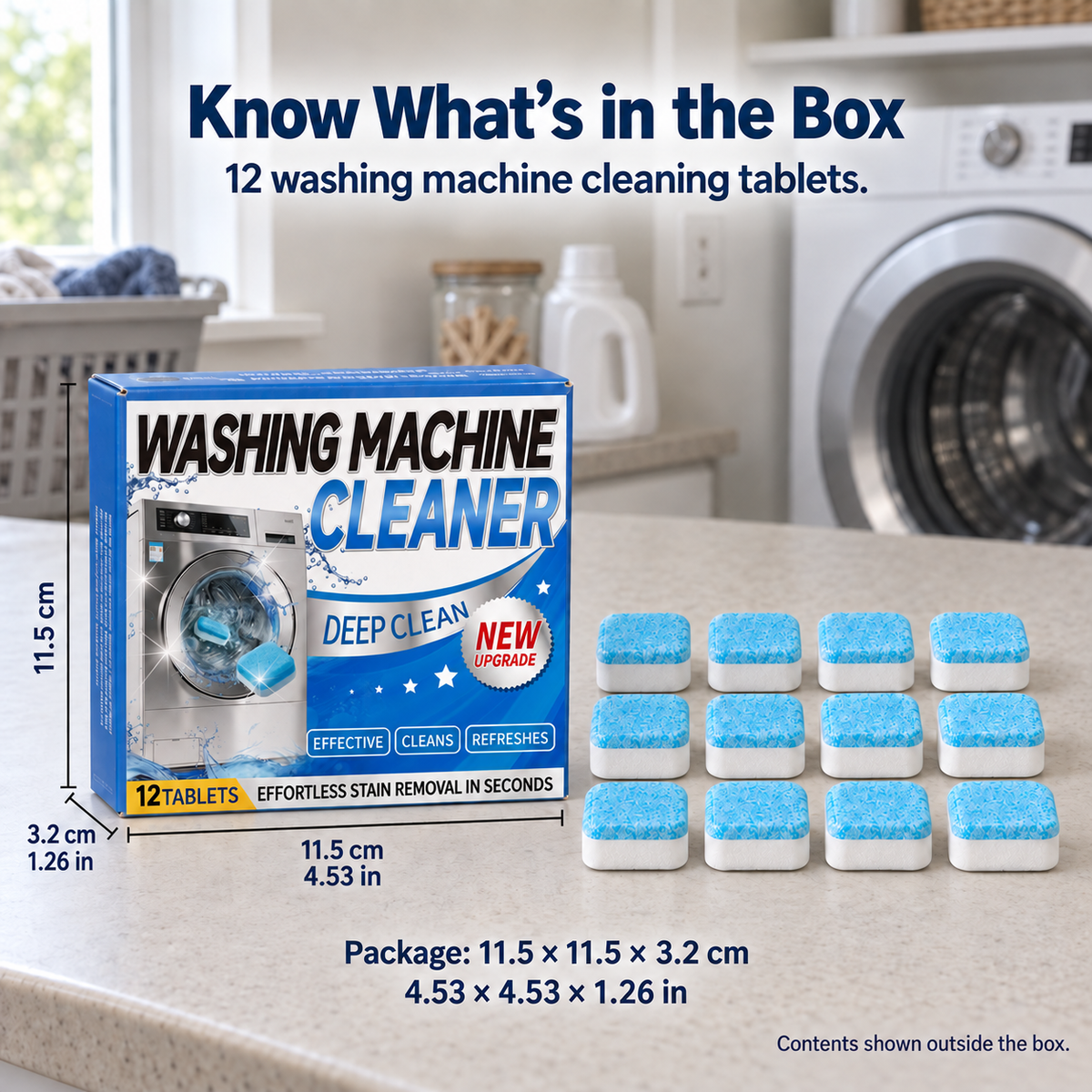
Original blue-and-white cleaning tablets in the illustrated carton, ready for empty-machine care.
12 tablets does not specify 12 cleans or 12 months. The machine, cloth and basket are not included.
Understand what the tablets do, where they work and what comes in the box.
It cleans the washing machine itself. Use it for empty-machine maintenance, not as your everyday laundry detergent.
It targets buildup and washing residue on internal surfaces the cleaning liquid can reach, helping loosen attached film that can cause stale odors.
A shiny drum does not mean every area is residue-free. Check the drum wall, the edges around the lifters and the bottom of the drum after cleaning.
Its cleaning focus is odor-causing residue. It helps loosen buildup at the source; fragrance strength is not the measure of a finished clean.
Hard-water support reduces interference from water hardness during cleaning. It is intended for routine machine care, not a promise to remove years of heavy scale in one cycle.
Foam volume alone does not tell you how well a cleaner works. These tablets use low-foam wetting to help the cleaning liquid make contact with residue.
Fine soil leaves with the cleaning liquid and drainage. Dispersion helps reduce particles sticking again, but it does not replace removing foreign objects from the filter.
Inspect and remove visible remnants in the drum, then check local areas such as the seal, detergent drawer and filter. A finished cycle is only one part of checking the result.
No. Seal folds, the detergent drawer and the filter each need their own inspection and maintenance. Combine drum cleaning with local checks, following your machine manual.
Blue and white describe the tablet's appearance, not a verified breakdown of its ingredients. The colors should not be read as formula names or separate chemical stages.
Look for less buildup in the original location and check the drum bottom for flakes or tablet pieces. Dark water, more foam or a stronger scent cannot replace these observations.
One box contains 12 tablets. Tablet count is the pack quantity; it does not directly specify a number of cleaning cycles or months of use.
The carton measures 11.5 × 11.5 × 3.2 cm, approximately 4.53 × 4.53 × 1.26 in. These are the box dimensions, not the dimensions of one tablet.
No. They are props used to show machine-care situations. This product contains 12 cleaning tablets in the illustrated carton.
Everyday moments. Different perspectives.
999+ reviews